Friday, January 16, 2026

It's over (cycler)

Hello,

After about a year and a half after the first Overcycler sold, I've chosen to stop manufacturing it...

Long story short, it is too burdensome to even produce one batch per month. I do love the fact that is sells well, being a labour of love, but for many reasons, it takes a bit of my health for each batch (stress, meeting deadlines, necessary attention to detail, ...).

I hope this project will end being manufactured again by some company in the synth business, I wouldn't ask for a lot of money on each sale to sell the rights even (and I do love Pi as a symbol of laicist love ;).

For now, the project stays open-source and free software and located at https://github.com/gligli/overcycler. Eg. it wouldn't require a huge effort to maintain the JLCPCB bill of materials, and besides PCBs, the rest is off the shelf form mouser, aliexpress, ...

As a side note, stopping production will also help me focus on my other projects and my music.

Of course I'll continue doing after-sales support but that's about it.

Fabrice GUILHAUME aka. GliGli.

Saturday, June 7, 2025

Overcycler back in stock!

The new batch of Overcycler is now ready at https://gligli.store !

From now on, only the fully built version will be stocked.

 Edit: A new batch of 10 is available!

Thursday, January 23, 2025

My new album: Out of this world (2025)

Monday, November 11, 2024

New Overcycler firmware release (build 2024-10-29)

What's new:

• New factory presets from Solidtrax.
• Firmware speed improvements, now the user interface won't slow down on modulation-heavy presets.
• New "Amplifier level" parameter, that can be used to level the volume of patches or to add even more overdrive at high levels.
• New "Wave Folder" WaveMod, that vertically (through amplitude) folds waveforms, ie. when they go past the maximum, they fold (or "bounce") back, and the WaveMod amount is the pre-amplification (from 1 to 16).
• New "Bit Crusher" WaveMod, that works by lowering the amplitude resolution of the single cycle (contrary to the "Grit" one, which lowers the frequency resolution).
• New "LFO Trigger" options, to reset the LFOs on each key press and to control how many periods they run.
• LFOs at speed 0 can now be used as a source of constant modulation.
• Patch names, that can be edited on a computer.
• Added "Perc" and "FX" as preset type.
• When the arpeggiator is in hold, new notes can be assigned regularly, allowing to play over an arpeggio pattern.
• Many user interface usability improvements.
• Bug fixes.

Download links:

https://github.com/gligli/overcycler/releases/tag/build_20241029

Edit: By the way, the synth will be back in stock next week! 

Thursday, October 24, 2024

Overcycler demo by Solidtrax / next firmware release

Solidtrax ( https://solidtrax.nl/ ) posted a great demo of presets he made for the Overcycler :)(many of these presets plus some more he made will be factory presets for the next firmware release).

By the way, the next firmware is currently in beta stage and will be released soon!

Here will be the major changes:

  • Firmware speed improvements, now the UI won't slow down on modulation-heavy presets.
  • New "Amplifier level" parameter, that can be used to level the volume of patches or to add even more overdrive at high levels.
  • New "Wave Folder" WaveMod, that vertically (through amplitude) folds waveforms, ie. when they go past the maximum, they fold (or "bounce") back, and the WaveMod amount is the pre-amplification (from 1 to 16).
  • New "Bit Crusher" WaveMod, that works by lowering the amplitude resolution of the single cycle (contrary to the "Grit" one, which lowers the frequency resolution).
  • New "LFO Trigger" options, to reset the LFOs on each key press and to control how many periods they run.
  • Patch names, that can be edited on a computer.
  • Many UI usability improvements.

Monday, August 19, 2024

Overcyler first batch ready

The first batch of Overcycler is now ready at https://gligli.store :)

For now, only the fully built version is stocked, DIY version will be available next batch!

Wednesday, August 7, 2024

GliGli's shop online!

I set up a shop to sell Overcycler, the link is: http://gligli.store (the first batch of 10 will soon be available there).

The final price for the fully assembled version is 314€ and the DIY will be 264€.

By the way, "Magical Synth Adventure" has posted a video showcasing Overcycler through sonicstate.com on Youtube :)


Edit: some photos of the synth:


Monday, June 24, 2024

Overcycler3 final prototype / factory patches demo

Due to issues with the first enclosure/PCB prototype, the project had a bit of delay, sorry for that!
The hardware is now based on a more "standard" PacTec PT-10 enclosure, and we had to redo the whole PCB so that it fits the form factor.

All in all, this made Overcycler way more ergonomic, with the panel now angled, and the 10 potentiometers and keypad below the screen.
This is also due to the reworked user interface, which uses digits to access 10 pages of controls, and A/B/C/D for options per page (* and # being global shortcuts).

I have made a video of the 15 (so far) factory patches. Finish will be slightly different in the final version (screws, ...) but this is very close to the final design.

Monday, February 5, 2024

Overcycler3 firmware done!

I have finished porting the firmware, and I am happy: I had no major modification to do on the prototype for everything to work :)

At a glance, what I added:
- Mono aftertouch (or "channel pressure").
- Automatic filter tuning.
- A bootloader, to allow easy and riskless firmware updates.
- A cleaner MIDI implementation with CC and NRPN.

By the way, I was able to implement the WaveMod called "crossover" in true polyphony, and even allow it on the 2 oscillators, a small demo:

This allows a 4 single cycle sound as "partials", here I modulate it with the oscillators envelope, we can also hear the aftertouch modulating the filter brightness.

Thursday, January 25, 2024

Overcycler3 update

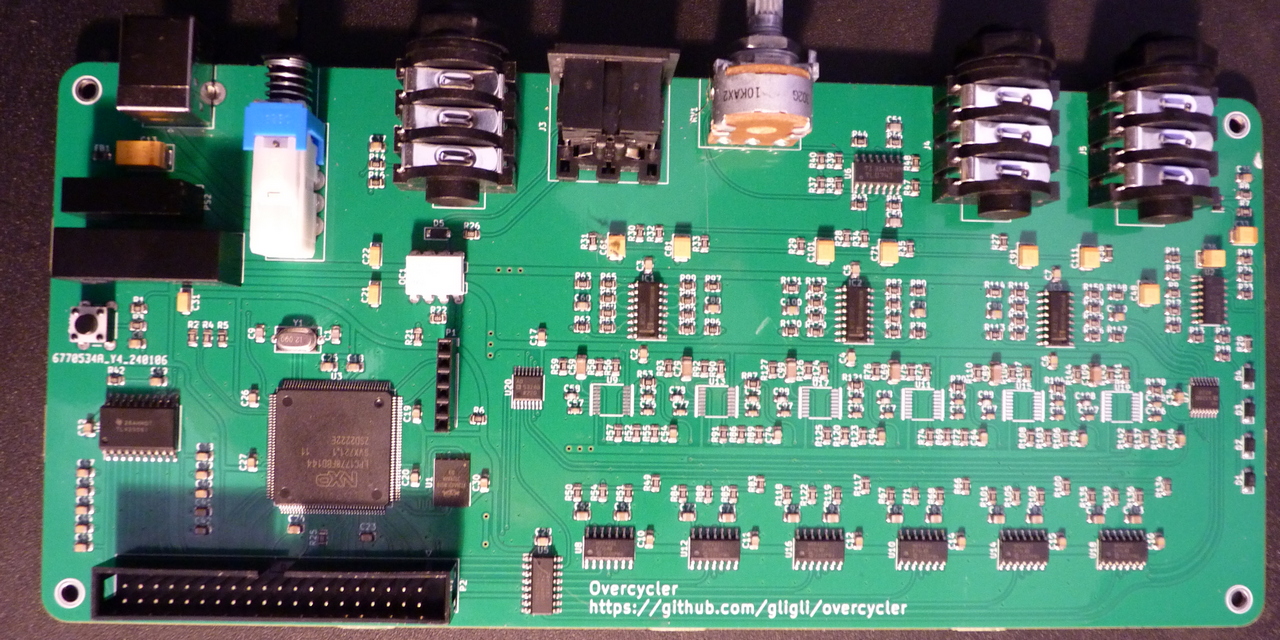
The PCB design is finished, and I received the (almost) entirely populated first prototypes from https://jlcpcb.com/ (they didn't have the SSI2144).

Here's a picture of the PCB:

I am now working on porting my firmware on this new version.

By the way, here's what has changed since my earlier post:
- One more envelope, dedicated to oscillators (the filter envelope was used beforehand, but it felt a bit cheap...).
- Instead of a SDCard slot, I now use a soldered flash chip, which will be accessable through USB.
- Shipped with a machined enclosure, the potentiometers, the display, the 16 keys keypad, the knobs, and probably a vinyl for the panel, assemble it yourself (about 250€), or entirely assembled (about 300€).

Tuesday, October 10, 2023

Overcycler as a fully assembled SMT PCB

Hello!

Now that there are cheap SMT clones of the SSM2044, I thought I could finally make this synth an affordable and easy to build DIY.

My idea is to offer this synth as a fully soldered (almost) entirely SMT PCB, and let the users wire the panel (10 potentiometers, a 40*4 character display and a 16 keys keyboard) and build the enclosure.

For now, it's hard to give a cost estimation, but let's say it would (probably) be around 200€ for a fully assembled board (add less than 100€ for the rest).

The firmware is now rather complete and well tested (by me :), here are the features:

  • 6 voice polyphony using hybrid synthesis (Digital "single cycle" oscillators / analog VCF and VCA).
  • 2 synchronizable oscillators per voice, duty cycle modulation on any waveform, 2 waveforms mix modulation (on oscillator 1), "grith" modulation (from a subtle veil to "ring modulation"-like sounds).
  • 2 complete envelopes with lin/exp choice and looping.
  • 2 complete LFOs with 6 modulation destinations.
  • 1 noise generator.
  • Voice panning on the stereo output.
  • 400 patches stored on SDCard, Single cycles (AKWF, PRophetVS, ...) also stored on SDCard.
  • Sequencer / Arpeggiator.
  • USB Powered with USB MIDI and regular MIDI.

 If people show interest, I'll start designing the new PCB!

Thursday, May 21, 2020

Sequential Circuits Multi-Trak firmware modifications release

Hello, I released version G.5 today with a fix for "Ext Clk" mode. After a few months of use, it seems it was the last bug left.

Here's the binary for 27C128 EPROM: mtrak.bin
And for 27C256 EPROM: mtrak32.bin (wider availability than 27C128 and compatible with this file)

Quick install how-to:
  • Dump patches and sequences thru MIDI. The upgrade procedure should not corrupt them but it's still safer to dump them before opening the synth.
  • Program the corresponding .BIN file to a regular erased 27C256 or 27C128 with an EPROM programmer. EPROM programmers (eg: TL866II) are not cheap but eg. there are services on the internet that do this.
  • Open the synth, remove the analog board.
  • Remove the old 28pin EPROM from the socket, keep it aside.
  • Fit the new EPROM, put the analog board and all back, and it should work fine!
  • To check the installed version number, press both "MIDI Channel" and "MIDI Mode" at the same time.

The project page: https://github.com/gligli/mtrakemu

I hope Multi-Trak owners will enjoy the added features of this firmware :) (by the way, I wonder how many of them there are in studios everywhere...).

Thursday, December 26, 2019

Sequential Circuits Multi-Trak firmware modifications


I started to work on a series of software modifications for the Sequential Circuits MultiTrak, mainly intended to improve usability in "live" or "jam" use.

As for the P600, I wrote an emulator of the digital part, which I used as a tool to code the modifications.


I had a setback: the MC68701 keyer from my Multi-Trak stopped working at some point, but I finally managed to read the contents of the chip and I was thus able to rescue it by reprogramming a new one :)
For those might have the same issue, here is the binary: mtrak_keyer_dump_MC68701S.bin
It can be programmed in an MC68701S or MC68701L but, beware, NOT in an MC68701U4L or an MC68701U4S.

Then, I finished the modifications of the main firmware, and managed to cram in the 3 that I wanted to do and everything seems to work well. I started from official version 2.2, which is the most recent and the most compatible. A version 3.0 exists but it is incompatible because the hardware is different, and therefore this modification will not work on it.
  • Synth voices can now be freely toggled ON/OFF, in sequencer mode (even when it is running, which brings a lot of options for "jam" use), in unison mode (to make 1-5 voices unisons instead of 6), or even in poly mode (alhough not very useful because the voices are still assigned).
    • "To Tape + track 1-6": Disable the corresponding voice, it really is a forced "note off" because the release stage is still played if the voice was sounding.
    • "From Tape + track 1-6": Re-enable the corresponding voice, the next assigned note can play again.
  • Pitch bender routing can now be changed from VCO to VCF:
    • "To Tape + Auto-Correct": Switch to Bender -> VCF.
    • "From Tape + Auto-Correct": Return to Bender -> VCO (boot default).
  • Disabled sending the sequencer notes to the MIDI output in "local off" mode ("MIDI channel + 9" to toggle it), allowing clean control of an external synth with the keyboard at the same time as the sequencer runs.
For technical reasons, these settings are not saved: there was about 50 bytes of free space in ROM, I already had to use many coder tricks to get everything in there!

I named the version "G.3", and it can be displayed as usual with: "MIDI Channel + MIDI Mode".

Here are the binaries:
And finally the project page on GitHub: https://github.com/gligli/mtrakemu

Edit:
Version "G.4" up, fixing two bugs with "local off" feature, same links a before!
Version "G.5" up, fixing one bug with "Ext Clk" feature, same links a before!

Tuesday, January 22, 2019

Arturia BeatStep Pro to Yamaha CS-10 CV Trigger

A while ago, I made this cable to drive my Yamaha CS-10 CV Trigger using my Arturia BeatStep Pro.
It's a bit unusually made and takes advantage of the way the Yamaha CS line of synths do "Trigger out" but it's easy to make and works just fine!

PotatoCad schematics folllows :)


NB: I recently found something nice about this cable: it can also be used to loop the CS-10 audio out back into the filter. Just plug the blue 1/4 inch jack into "external input", the orange one into "output" and the BSP end into your mixer, set "Ext" mode and tweak the corresponding potentiometer to taste :)

Sunday, August 28, 2016

Overcycler2 updates

I made several improvements to Overcycler2 since my last posts:

  • Added a new WaveMod for oscillator 1 that can dynamically blend 2 waveforms. The blending ratio can be set manually, with an LFO, or with the filter envelope. In that last case it's paraphonic (due to CPU limitations), that means the blending ratio always follows the last triggered filter envelope.
  • Made the vibrato a fully featured second LFO.
  • Added LFOs to filter resonance routings, this can create really interesting timbres due to the way resonance volume compensation drives the pre-filter mixer.
  • Doubled the synth refresh rate (envelopes, LFOs, ....), now at 4Khz.
  • Added basic support for lower sample count waveforms. That allowed me to use the cool ProphetVS waveforms.
  • Various tweaks & usability improvements.

I also made a video demonstrating some of the user interface of Overcycler2 and then played some new patches:


Tuesday, October 13, 2015

Overcycler2 demo track


All sounds were made with Overcycler2, my DIY 6 voice hybrid analog synthesizer, drums included.
Effects: reverb, equalizer, limiter.

By the way, I made several changes since the patches demo:
  • Oscillators sound improvements: 96KHz sampling, better interpolation (hermite) for improved treble response, major reduction of sound crackling (it can be heard in the last patch of previous demo).
  • Added the polyphonic 2 track step sequencer from P600fw. 20*2 sequences can be stored for now.
  • Added sequencer/arpeggiator and keyboard transpose.

Thursday, October 1, 2015

Overcycler2 patches demo

Here's a demo of a few patches on Overcycler2, showing some of its sound palette.
They tend to have lots of overdrive to get an idea of the raw synth sound but by adjusting the pre-filter mixer levels, it's perfectly possible to get tamer sounds.


By the way, I recently started implementing oscillator sync, I didn't demo it yet because I think I can improve the way it sounds (there's a bit of aliasing on the upper range right now).

Sunday, September 27, 2015

Overcycler 2 lives!

I finally received my PCB!

Unfortunately I found 2 bugs on the board revision I sent for production but it was too late, so there are a few small straps on it.

Anyway, I soldered all the components, did a bit of debugging and it finally worked, all 6 voices!
It works quite fine actually, better than on breadboard. Eg. the potentiometers ADC captured lots of noise while on breadboard which made adjusting values hard. Here the noise usually doesn't exceed 1 bit.
Overall much less noise on the PCB, which make the VCAs really quiet when closed.


Pic of the board (sorry, cellphone quality):


(The heatsink is temporary, I will use the case itself as a heatsink.)

Now I just need mount the board inside the case, solder the connectors (I have yet to receive them) and the synth will be done :)

Sunday, September 20, 2015

Overcycler 2, the return

Overcycler, my homemade polyphonic hybrid synthesizer, while being a working synth that I made music with, had quite a few caveats in its design, here are a few of them:

  • Being a 5 PCB design, I tought it was a good idea to have voice cards but it just complicated the design and made the enclosure a lot harder to build.
  • The enclosure was too small, not very practical, and overall badly built. The fact that it was too small also forced me to make a lot of hacks to fit everything inside.
  • The display was too small, which made parameters hard to read fast.
  • VCAs were noisy, bleeding audio even when fully closed and gain staging was wrong, which made the sound too tiny past the filter.
  • Using the VCA to compensate for resonance volume loss, it seemed like a good idea, saving the cost of one more VCA per voice but it made the synth sound small with resonance, as the SSM2044 lose its overdrive the more you added resonance.
  • DAC / sample & hold mechanism for CV control. Not a bad thing in itself but very sensitive to noise.
  • Link capacitors in some parts of the voice design had too small values, leading to poor bass response.
  • Overall just a prototype that was left unfinished.

So, as the title says, I'm making Overcycler 2, a full rebuild / redesign of Overcycler. Besides having a more enjoyable synth to make music with, I hope this will make it a properer DIY project that others can build. As you can guess all the previous issues were addressed:

  • Single PCB design, roughly A5 size (153mm x 209mm).
  • Bigger, better built, nicer enclosure, with wooden sides for that vintage vibe :)
  • Bigger display, 40x4 characters instead of 20x4.
  • Lots of work on gain staging, to try to make the synth always sound good.
  • Using the pre-filter mixer to compensate for resonance volume loss, requiring no additional parts and nicely doing the job. That was kind of an eureka moment when I thought about it :)
  • 8 channel DAC chip to handle the CVs. They are quite expensive so I chose to ditch multitimbrality (which never worked on overcycler) to keep the costs low.
  • Bigger and better quality link capacitors.
  • This time I really want to make it proper. 

By the way, I added a voltage controlled noise generator of my design and also removed the VC master volume to replace it by a dedicated potentiometer.

Right now I have a fully working voice on breadboard, a prototype PCB that is sent for production and I just finished drilling / preparing the enclosure, here are a few pics of it:
 

Now compare it to this and you will see what I mean by better built :)


To be continued when my PCB arrives!

Project page: https://github.com/gligli/overcycler